

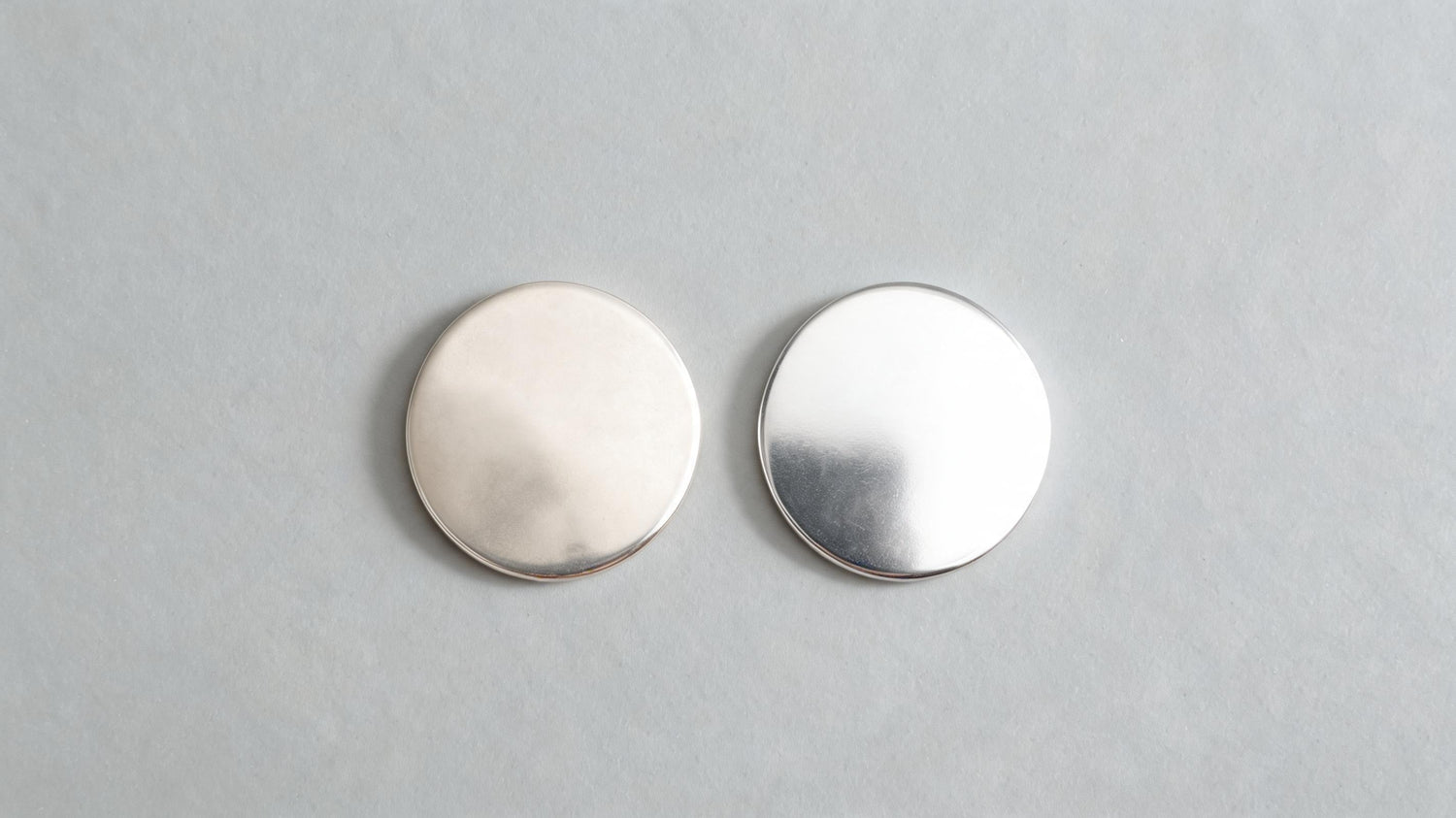
Part 2 of a series on what's really in your silver jewelry. Sterling has a younger, more tarnish-resistant cousin — and some of the makers I carry choose it on purpose.
Last time, I sorted out the four things the word "silver" can mean on a jewelry listing — sterling, plated, toned, colored — and argued that the difference that actually matters is quality versus cheap, not sterling versus plate.
This week I want to complicate that a little, because even inside real silver there's more than one kind. There's the sterling you already know. And there's Argentium, which is what you get when someone sits down and asks why sterling has to behave the way it does.
Most improvements in jewelry are made for the person wearing the piece. Argentium is unusual: it started as a fix for a problem only the maker ever sees.
What it actually is
Standard sterling is 92.5% pure silver and 7.5% other metal, almost always copper. The copper is what makes silver hard enough to work with — pure silver is too soft for daily wear — but copper is also the troublemaker. It's the reason sterling tarnishes, the reason it can leave a green mark on reactive skin, and the reason smiths fight something called firescale at the bench.
Argentium keeps the silver and swaps part of the copper for a small amount of germanium — the same element that turned up in the first transistors. That one substitution changes how the metal behaves. It comes in two main grades: 935, which is 93.5% silver, and 960, which is 96%. Both hold more pure silver than ordinary sterling, and 960 is pure enough to meet the old Britannia standard. So Argentium isn't a sterling substitute or a sterling knockoff. By the numbers, it's more silver than sterling, not less.
Where it came from
Argentium is genuinely modern, which surprises people who assume every silver tradition runs back centuries. It came out of a research lab — the Art and Design Research Institute at Middlesex University in London — where a silversmith and metallurgist named Peter Johns began studying what germanium does to silver alloys in 1990. The story I love: Johns had taken a contract to find new uses for germanium for a metals company, and around the same time a student asked him about firescale. The two questions met in his head, and Argentium is what came out.
Firescale, and why a wearer should care about a maker's problem
Firescale — sometimes firestain — is the dark, bruise-colored shadow that forms under the surface of sterling when it's heated during fabrication. It's the copper oxidizing where you can't easily reach it. Silversmiths spend real time grinding, polishing, and disguising it, and it can surface months later beneath the finish like a watermark you didn't know was there. Argentium doesn't form it. That was the whole original point.
But here's why it ended up on your side of the counter. The same germanium that solves firescale migrates to the surface of the finished piece and forms a thin, clear oxide layer that protects the silver underneath. The practical result is a silver that resists tarnish far longer than ordinary sterling. Less copper at the surface also means a cooler, whiter color — no warm undertone to polish back. And it's nickel-free, which matters more than you'd think (more on that next week).
For the maker there's even more to like: Argentium can be fused to itself without solder and hardened with a simple low-heat treatment, which opens up designs that are awkward in standard sterling.
The honest part
Argentium is not a miracle, and I won't sell it to you as one. It costs more — more silver content plus a specialty alloy — so a piece in Argentium usually carries a higher price than the same idea in sterling. Plenty of excellent makers prefer traditional sterling and have good reasons to. And tarnish-resistant is not tarnish-proof: given enough time and air, any silver will dull, and a polish brings it back. What Argentium buys you is more time between polishes, and a maker who didn't have to fight the metal.
Some of the makers I carry reach for it on purpose. Momo Glassworks uses it for all their ear wires, and Bijou by Sam uses it for nearly any silver that touches an earlobe, because of the reduced likelihood of allergic reactions.
About this series
This is Part 2 of three.
Part 1: What "silver" jewelry actually is — sterling, plated, toned, colored, and how to tell what you're holding.
Part 3 (next Thursday): Sterling silver can be hypoallergenic, and most "silver allergies" aren't allergies to silver at all. I'll explain what's actually going on — and where Argentium fits, since nickel-free is part of that story.
As always: every silver-bearing piece at Harold & Hazel names its material plainly. Sterling, Argentium, quality plate — all from makers I know by name.
—Amanda

Leave a comment
This site is protected by hCaptcha and the hCaptcha Privacy Policy and Terms of Service apply.